Marketing Velocity Is the Last Operational Moat

Executive Summary
- The playing field on AI and MarTech tools has leveled. Writing tools, image generators, and automation platforms are now accessible to every marketing team. Volume and Variety are no longer competitive advantages on their own. They are entry requirements.
- Marketing velocity is the V that remains: the total time from "we know something changed" to "we have something live that customers can react to." This is the one V a subscription cannot fix.
- Velocity lives in the handoff chain, between your tools, not within them. It is killed by sequential dependencies: brief to agency, agency to review, review to format, format to distribution.
- BCG found that brands rebuilding their content supply chain cut campaign cycle times from 25 weeks to under 8. Those brands are tripling marketing ROI, speed, and volume simultaneously.
- The bottleneck is not talent, hard work, or budget. It is the infrastructure connecting insight to activation.
The Tools Are Table Stakes
Your AI and MarTech tools have never been better. Neither have your competitors'..
In the past three years, writing assistants, image generators, social automation platforms, and AI-powered briefing tools have become accessible to virtually every marketing team at virtually every budget level. And yet, BCG's December 2024 research found that only one in four companies are finding real value from AI at scale. The tools are everywhere. The results are not.
That gap is not an effort problem. It is an infrastructure problem.
Volume and Variety are necessary. Every serious brand is investing in both. But the tools that enable them have spread fast enough that they no longer separate leaders from laggards. The competition is no longer about who produces the most or covers the most channels. It is about who can move from signal to shipped content the fastest.
Which leaves one variable: marketing velocity.
The Three V's of Marketing
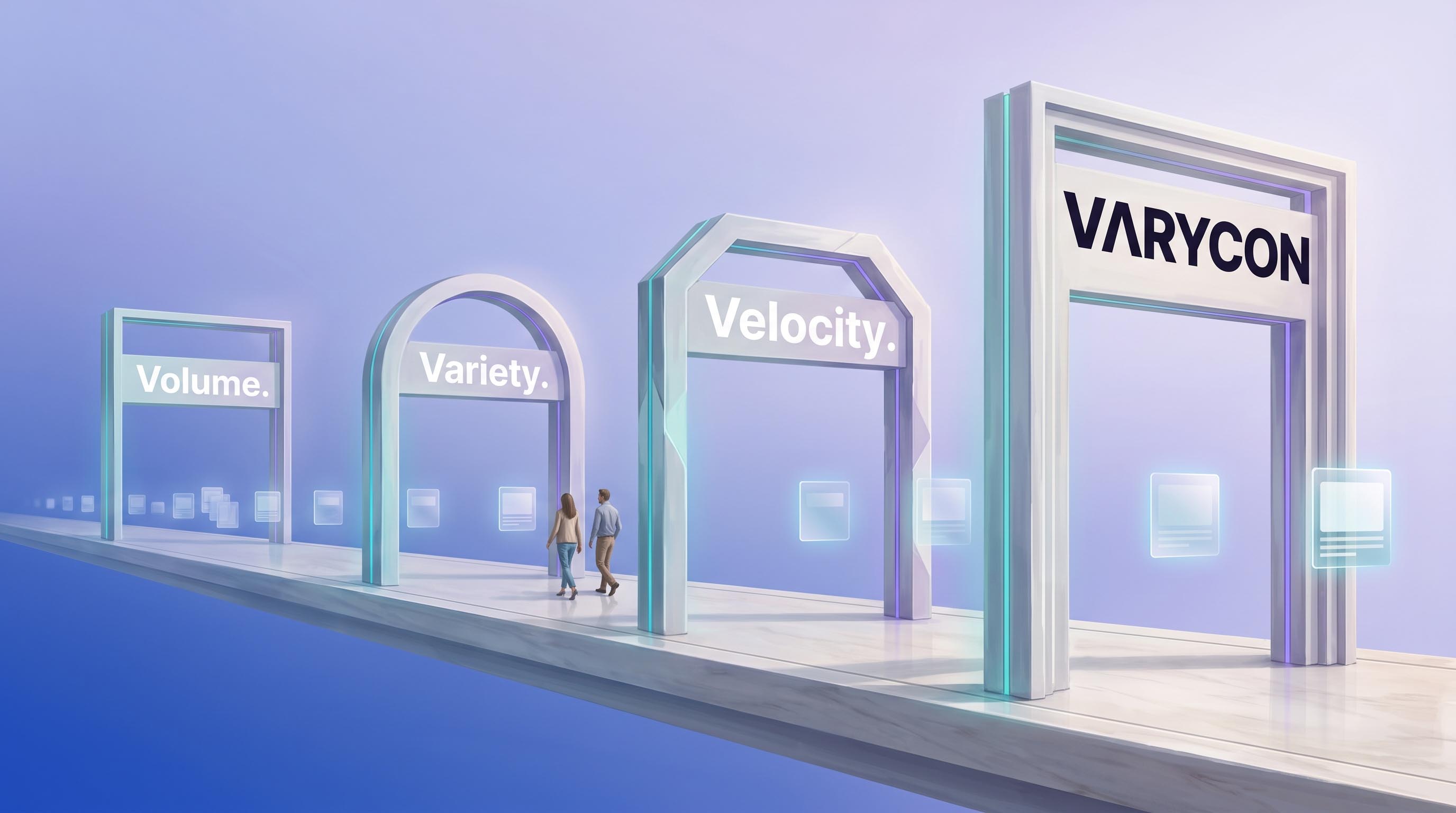
Every marketing operation can be measured across three dimensions: Volume, Variety, and Velocity.
- Volume: how much content you produce. Tools have largely addressed this. Most enterprise teams generate more assets than they know what to do with.
- Variety: how many formats, channels, markets, and use cases you cover. Tools have helped here too. Translation plugins, format adapters, channel-specific templates. The infrastructure for Variety is maturing fast.
- Marketing velocity, or content velocity as operations teams often call it: the time from a market signal to a live response. This is the dimension where tools fall short. Not because the tools are bad. Because Velocity does not live inside any single tool. It lives in the process connecting them.
Volume without Velocity is just inventory.
Marketing Velocity: The Last Operational Moat
Velocity is not about moving faster for its own sake. It is about how long it takes your organization to go from "we think something changed in the market" to "we have something live that customers can react to."
Reframed that way, content velocity is a structural metric, not a production one. Closing the gap requires a system, not just tools. It requires infrastructure. That is why it is the last operational moat: buying better tools does not close it.
"Agentic AI can triple marketing ROI, speed, and volume. One global retailer rebuilt its content supply chain, cutting cycle times from 25 weeks to under 8." - BCG (2025)
Where Velocity Dies: The Space Between Your Tools
The Velocity Gap is not caused by slow people or weak tools. It is caused by what happens between them.
In a typical enterprise campaign cycle, a market signal passes through six to eight sequential handoffs: insight capture, brief development, agency briefing, creative production, review and compliance, format adaptation for each channel and region, and final distribution. Each handoff requires a human to move context from one system or team to the next. Each adds days. Aggregated, they add months.
Three things mark organizations that have closed this gap:
- Short path from insight to shipping: minimal handoffs, decisions made while the signal still matters.
- Low cost of experimentation: when iteration is cheap, teams test rather than default to safe bets.
- Ship to learn, not to complete: launches are mechanisms for finding out what resonates, not endpoints.
BCG (2025) found that 86% of CMOs say their creative agencies are not yet using AI at scale. This is not just a stat about agency readiness. It is proof that the handoff chain is the bottleneck. The moment a brief leaves the building, it enters a legacy production environment. The supply chain is only as fast as its slowest node.
Diagnosing Your Content Velocity Gap
Most brands have never measured their content velocity. Not because the data does not exist, but because no single system tracks the full cycle. The answer requires assembling numbers from at least three places: project management tools, agency timelines, and distribution logs.
Three questions that reveal where your gap lives:
- From the moment your team spots an opportunity (a competitor launch, a trend spike, a seasonal window), how long until a brief is written and approved? If that takes more than a few days, the gap starts here, before a single asset has been made.
- How long from an approved brief to first creative output? Count every handoff, including any time the brief spends outside the building with an agency or production partner.
- How long from final creative approval to a live asset in market? This is where most brands discover that "approved" and "live" are weeks apart, separated by format adaptation, compliance review, and distribution setup.
What is the total? For most enterprise brands, the full cycle runs between 12 and 25 weeks. That number is your Velocity Gap.
If you cannot calculate it because the data is spread across systems that do not talk to each other, that is itself the answer.
The Infrastructure Question
What makes a content supply chain fast or slow comes down to one structural choice: sequentiality or parallelism.
In a sequential chain, each handoff waits for the previous one to complete. Brief waits for alignment. Creative waits for brief. Review waits for creative. Everything waits, and the chain is as slow as its slowest link.
In a parallel one, briefs generate in structured formats that feed directly into production. Brand guidelines are coded in rather than reviewed at the end. Distribution formatting happens at generation, not after approval. The handoff chain is not made faster. It is removed.
Why the V in VARYCON Has Always Stood for This
Volume, Variety, and Velocity are the three operating conditions a modern content supply chain must deliver simultaneously. A brand with Volume and Variety but no Velocity is producing content that arrives after the conversation has moved on. Closing the Velocity Gap does not require better strategy or more creative talent. It requires different infrastructure.
VARYCON builds the content supply chains that close the Velocity Gap. Not by making individual tasks faster, but by removing the handoff chain that makes the gap structural in the first place. The result is a brand that can respond to what the market is doing now, not to what the market was doing six months ago when the brief was written.
One DAX-listed CPG enterprise rebuilt its content supply chain with VARYCON and cut delivery time by 61%. That same model now runs across more than 20 markets.
Volume, Variety, Velocity. VARYCON is the fourth V: the infrastructure that makes the other three possible.
If your marketing organization has never measured the time from signal to shipped content, the audit above is the place to start. It will tell you more about your competitive position than any asset count or campaign volume metric ever will.
Contact VARYCON to close your Velocity Gap.
Related Questions
What is marketing velocity?
Marketing velocity is the speed at which a marketing organization converts a market signal into live content that customers can see and react to. It is measured as the total time from insight to activation, including all internal handoffs, agency roundtrips, review cycles, and format adaptation steps. High marketing velocity means a brand can respond to market shifts while they are still relevant. Low marketing velocity means content arrives after the window has closed.
What is content velocity and how is it different from marketing velocity?
Content velocity and marketing velocity describe the same underlying gap from different vantage points. Content velocity is the operations-side term: how fast content moves through the production pipeline. Marketing velocity is the strategic framing: how fast a market signal becomes a live response. Both point to the same structural problem, which is the sequential handoff chain that sits between insight and activation. The label matters less than the measurement.
What is the Velocity Gap in marketing?
The Velocity Gap is the measurable delay between when a market signal occurs and when a brand has live content responding to it. It is not caused by slow creative teams or inadequate tools. It is caused by the sequential handoff chain connecting those tools: each system waits for the previous one to complete before the next can begin. BCG found that one global retailer closed its Velocity Gap by cutting campaign cycle times from 25 weeks to under 8 through integrated, agentic content supply chain infrastructure.
How do you measure marketing velocity?
Measuring marketing velocity requires mapping the full cycle from signal to shipped content. Start with four questions: How long from signal to approved brief? How long from approved brief to first creative output? How long from creative approval to live distribution? What is the total? Most brands find the data spread across project management tools, agency timelines, and distribution logs. No single system tracks the complete picture. If you cannot calculate your total cycle time, you have already found the infrastructure gap.
What is the difference between AI tools and content supply chain infrastructure?
AI tools address individual tasks: writing a headline, generating an image, translating a paragraph. Each tool makes one step faster. Content supply chain infrastructure addresses the process connecting those steps: how a brief becomes a brief, how creative moves into review, how an approved asset reaches distribution in the right format for every channel. The Velocity Gap does not live inside any single tool. It lives between them. Closing it requires infrastructure, not more subscriptions.